Roadmap
Phases 0 through 7 are done: the proxy is production-ready and horizontally scalable, a full bug / security / UX audit shipped as v0.2.5 (every finding fixed), and the v0.2.x series since then has been an operator-driven polish loop — short releases, each validated live on a real deployment before the next. Phase 8 (external auth) is the main optional, demand-driven work left. For what changed in each release, see the release notes.
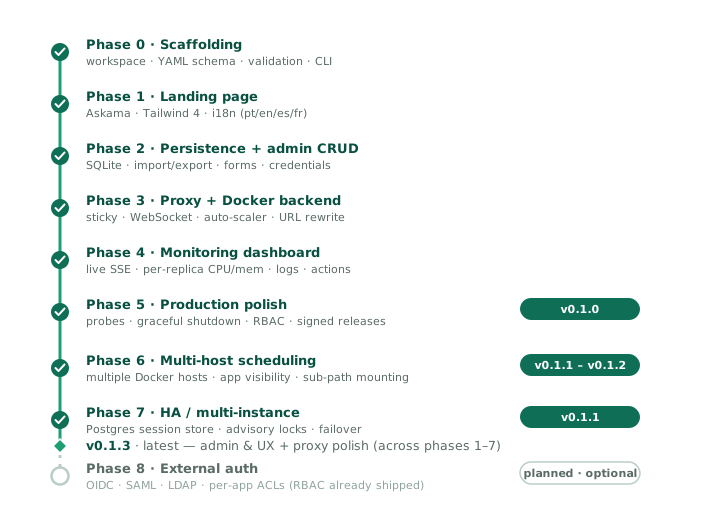
Shipped
Phase 0 — Scaffolding
The Cargo workspace, the ShinyProxy-compatible YAML schema, env-var
interpolation, two-phase validation, and the ruscker validate /
show / inspect CLI.
Phase 1 — Landing page
The public portal rendered from config with Askama + Tailwind 4 (no Node toolchain), full i18n in pt-BR / en-US / es-ES / fr-FR, theme and locale cookies, and the kind-tinted card grid with filters.
Phase 2 — Persistence + admin CRUD
SQLite as the source of truth (sqlx, embedded migrations),
ruscker import / export to round-trip YAML, and the admin panel:
apps list + spec form, image/media library (WebP conversion), an
AES-256-GCM credentials store, the landing-page editor, and an audit
log.
Phase 3 — Proxy + Docker backend
HTTP forwarding, sticky sessions (HMAC-signed cookie), WebSocket proxying, the Docker backend (spawn / stop / stats / logs via bollard), per-spec replica pools, the auto-scaler (scale-to-min, scale-up on saturation, scale-down on idle with hysteresis), the session tracker + heartbeat sweeper, absolute-URL rewriting so unmodified Shiny/Streamlit apps work behind a sub-path, and per-container CPU/memory limits.
Phase 4 — Monitoring dashboard
A live dashboard over Server-Sent Events: aggregate cards,
per-replica state / uptime / sessions / CPU + memory (with
sparklines), one-shot and live-follow logs, per-replica
stop / restart, and a Prometheus /metrics endpoint.
Phase 5 — Production polish → v0.1.0
/healthz + /readyz probes, graceful shutdown (session drain),
structured JSON logging, per-API rate limiting + CORS, request
body-size limits, validate --strict-compat migration pre-flight,
role-based access control (Viewer / Editor / Admin with per-user
password accounts), smart-routing headers (X-Forwarded-Prefix …),
and distribution: a multi-arch Docker image, a Debian package
with a hardened systemd unit, static musl tarballs, a curl | sh
installer, a Homebrew tap, and cosign-signed release artifacts.
Production milestone. Ruscker’s idle footprint is ~14 MB — the JVM-based proxy it replaced, on the same machine serving the same apps, sat at ~540 MB. A real 31-spec config migrated with no unsupported features.
Phase 6 — Multi-host scheduling → v0.1.1 / v0.1.2
A MultiHostDockerBackend that talks to several Docker hosts, with
bin-pack vs spread placement and per-spec anti-affinity (“replicas on
different hosts”) — behind the existing ContainerBackend trait, no
proxy changes. Shipped alongside per-group / per-user app visibility
(access-groups / access-users) and sub-path mounting
(server.context-path / --base-path).
Phase 7 — HA / multi-instance → v0.1.1
A Postgres SessionStore and a shared config catalog so several Ruscker
instances behind an L4 load balancer can share state and any instance
can serve any session; one scaler leader via Postgres advisory locks,
with failover. A runnable 2-instance compose harness lives in
examples/ha/. See Deployment shapes.
Post-phase polish → v0.1.4 – v0.2.5
Incremental improvements shipped after Phase 7 — culminating in the v0.2.x series: the admin redesign to the new visual language (dashboard, Apps editor, the Appearance tab, Logs, Disk), and the v0.2.5 audit release (18 fixes across proxy correctness, security hardening, reliability and admin UX — see the release notes).
Demo app images. The Dash, FastAPI, and Quarto showcase cards now
point to dedicated milkway/ruscker-*-demo images on Docker Hub.
The Quarto demo is a static nginx image (~67 MB); Dash and FastAPI serve
at the root without needing SHINYPROXY_PUBLIC_PATH. Demo forks for
Shiny, Streamlit, and Voilà are backlog — those cards still point to
upstream images.
URL-rewrite modernization. The runtime shim that rewrites relative
asset paths under /app/{id}/ is now generalized to patch
script.src, link.href, img.src, and setAttribute, which retired
the Voilà-specific rewriter. The Jupyter-config rewriter (rewrite_jupyter_config)
is kept: JupyterLab builds absolute same-origin API URLs from
PageConfig.baseUrl that a root-relative shim cannot intercept. A
full absolute-URL Path B rewrite (handling apps that hard-code
window.location.origin) is deferred — the current shim covers all
validated app types.
Credentials. The named-credential store now accepts a pure
${VAR} env-ref in addition to an AES-256-GCM literal, resolved only
at container pull time. The spec form’s Registry section is now a
credential picker; inline domain/user/password fields remain as
back-compat.
Media library. Built-in logos are seeded into the unified media library (deletable, with an “in use” badge). The spec-form image picker supports inline upload. Gallery pages are paginated with search.
Portal logos. The landing editor supports per-slot logos (header / footer) with alignment (left / center / right), an optional link, and a per-logo height.
Performance. gzip/br compression on admin and landing responses;
?v=<version> immutable cache headers on bundled CSS/JS; ETag on media
assets; WebP thumbnails; bounded Docker stats fan-out with a
configurable metrics-interval.
Security fixes. API routing uses in-flight count (not seats);
charset validation on usernames and credential names; admin password
fields are write-only in the UI; ${VAR} resolution returns an error
when the variable is unset (names the missing variable).
Disk management & admin polish (v0.1.32–v0.1.33). A new Disk panel reclaims space: remove containers, prune every stopped one (label-scoped, never touching a non-Ruscker container), and remove unused images — individually or all at once. Deleting an app now reaps its containers instead of leaving orphans. New accounts must change their password on first login. A one-line startup banner (version, bind, base path, Docker, database, spec count) shows in the admin Logs tab at the default log level. The Portal logos editor reuses the spec form’s image gallery picker.
Docker-by-default & Portal branding (v0.1.34–v0.1.35). serve
auto-connects to Docker when the daemon socket is reachable (pass
--no-docker for landing-only); showcase demos seed with
min-replicas: 0 so a fresh install no longer pre-spawns every demo
container. The Portal gains per-theme colours (independent
background/text/accent for light and dark) and logos that integrate
into the chrome — a header-left logo replaces the Ruscker mark,
header-right trails the buttons, footer-right trails the version, and a
center logo is centred within the bar; each takes an optional margin.
The landing editor is reorganised into labelled section cards with a
sticky Save bar, logos are edited as cards with segmented
position/alignment pickers, and the live preview mirrors the real portal
chrome. The social-share og:image auto-defaults to the header logo
(else the Ruscker mark) and gets a gallery picker. Finally, the live
dashboard streams through reverse proxies (X-Accel-Buffering: no), so
new containers appear in real time even behind nginx on a subpath mount.
The design-handoff sprint (v0.2.6 – v0.2.13). A rapid, live-tested series that brought the whole admin to the design handoff and fixed what real operation surfaced, in days:
- Apps list — archive / restore an app in place (the card leaves the public portal, nothing is lost) and delete with confirmation, right from the table; toggles update the row without a reload or a scroll jump.
- Appearance, end to end — one Logos section with an inline main-logo picker; the header background as an explicit Preset / Solid / Gradient choice; per-theme (light / dark) values for the header, the default card covers and the palettes — with a draggable angle dial, Inherited ⇄ Own pills, layout tiles, a light/dark switch on the live preview, and a confirmed “Restore defaults”. The HTML-blocks editor gained inline editing.
- Landing content — the intro paragraph fills the row (justified, hyphenated per locale) and understands inline Markdown (bold, italic, links — escape-first, never raw HTML).
- Media — same-name uploads keep both images (the new one is renamed and announced), and picker tiles show filename captions so look-alikes can’t be confused.
Private-image & deploy robustness (v0.2.14 – v0.2.19). Driven by an operator bringing a private Plumber2 app online: Docker Hub credentials are normalised so they apply reliably, the credential picker moved beside the image field, a force re-pull (“Update image”) handles a re-published tag, and a boot crash now surfaces the container’s own error + exit code instead of a generic “no port binding”. Plus catalog cards expand their description on hover, and the dashboard’s stop/restart actions show in-progress feedback.
Migration fidelity, performance and citation (v0.2.20 – v0.2.44).
Bringing a real ShinyProxy catalog across drove import fidelity
(container-volumes, logos ingested into the Media library) and a
performance audit whose sharpest finding was the live dashboard: it held an
SSE connection open, which starved the browser’s per-origin connection pool
where a reverse proxy served Ruscker beside another app on one hostname, so
it moved to polling a snapshot endpoint. Apps also became cold-start by
default, the Admin panel gained scheduled, run-to-completion ETL jobs with
run history, log tails and failure alerting, and the project became citable
with a DOI archived per release.
Reliability and identity (v0.2.45 – v0.2.49). Step-up two-factor
authentication can be required per app, with recovery codes and
trusted-device grants. The scaler learned to self-heal when a container
changes outside Ruscker — an external docker rm -f or an OOM kill no
longer leaves a dead app behind — reconciling from an authoritative
liveness check rather than assuming absence means stopped. A new Activity
section records who logged in and who opened which app, captured off the
proxy’s hot path.
Timezones and delegated administration. Cron is no longer read on the
UTC clock: server.timezone names the IANA zone the scheduler evaluates
expressions in, and the Schedules page labels firing times in that same
zone. Leaving it unset preserves the historical UTC behaviour, so upgrading
never moves an existing job. Other persisted admin timestamps stay in UTC
and are converted in the browser to each viewer’s own zone.
Editor delegation is row-scoped from current group memberships across
Applications, Users, and Groups. Open apps remain available to every
Editor, Media is shared, and an out-of-scope target returns 404.
Admins and the break-glass token remain unrestricted. Account deletion,
CSV user import, MFA reset, and creating, renaming, or deleting a group
remain Admin-only.
Planned (optional)
Demand-driven — Ruscker is complete and useful without it.
Next up (small, operator-driven)
Tracked in the GitHub issues; picked up as real usage asks for them:
- “System” tab in the admin — a read-only diagnostic view of the effective server configuration (issue #766, decision pending).
- Personal highlights — let each visitor pin their own favourite apps (cookie for anonymous visitors, DB for signed-in ones, issue #519).
- Markdown in app descriptions — the intro already supports the inline subset; extending it to card descriptions is deferred until there’s a concrete need (issue #812).
- First-party demo images — fork the remaining showcase demos
(Shiny, Shiny for Python, Streamlit, Voilà, R Markdown) into
milkway/ruscker-*-demoimages that serve at the root (issues #389–#397). - Hardening follow-ups — live end-to-end validation of the WebSocket arc on Shiny/Streamlit (validated against Jupyter today). (The post-drop scale-down cooldown that tamed the seats=1 long-session flap has since shipped.)
Phase 8 — External auth
OIDC (Keycloak / Auth0 / Google), SAML, and LDAP. Per-app access lists and the Viewer / Editor / Admin model already ship, including group-scoped Editor delegation across Applications, Users, and Groups. This phase is only the federated-identity layer on top.
Explicitly out of scope
- Kubernetes backend — possible as a future
ContainerBackendimpl, but not a committed phase until there’s demand. - App-ecosystem features (pause/resume, snapshots) — these are ShinyProxy Pro territory.
- Multi-tenancy / billing and a public app marketplace.
What “done” means
After Phase 5, Ruscker can drop in where ShinyProxy runs today:
ruscker import application.yml --db /var/ruscker/ruscker.db- Stop ShinyProxy.
- Start Ruscker on the same port.
- Verify with the same browser URL.
Phase 8 is for organisations with federated-identity or fine-grained per-app access needs. Progress is tracked in the GitHub issues.